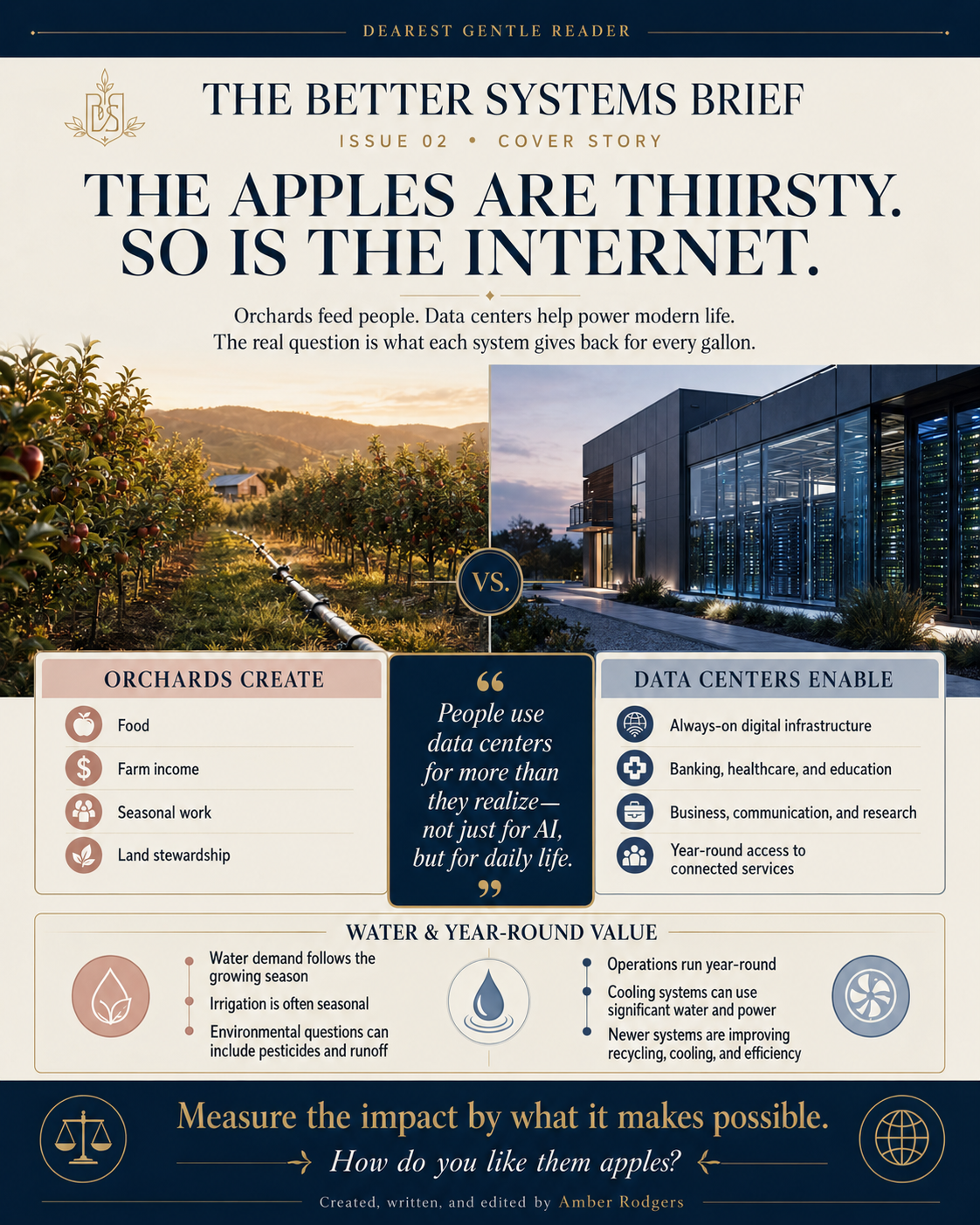
Somewhere in America, an apple orchard is waking up before sunrise. Irrigation lines begin their work. Tractors grumble. Somebody checks the fruit, somebody checks the weather, and somebody has already developed a personal disagreement with a bug.
A few miles, or perhaps a few states, away, a data center is also awake. It never went to sleep. Rows of computers are handling payments, medical records, navigation, business software, research, music, cloud storage, video calls, and approximately forty seven forgotten passwords.
Both places need land. Both need energy. Both create economic value. Both can affect nearby communities. And both may require a serious drink of water.
The kitchen table math
Water comparisons can turn slippery fast because no two orchards or data centers are identical. Orchard demand changes with acreage, crop, climate, rainfall, soil, and irrigation method. Data center demand changes with computing load, weather, cooling equipment, operating temperature, and whether the facility uses evaporative, dry, liquid, or hybrid cooling.
So this is an illustration of scale, not a universal rule.
Washington State University uses an orchard example with about 35 inches of irrigation water per acre during a season. One acre inch is about 27,154 gallons. Across 100 acres, that works out to roughly 95 million gallons during the growing season.
The Department of Energy publishes cooling tower estimates for systems operating at full load. Its table shows a 400 ton system using about 16,710 to 21,920 gallons per day, depending partly on how many times the water is cycled before discharge. If that example is scaled only to illustrate a much larger 5,000 ton cooling load, the annual range lands near 76 million to 100 million gallons.
But the orchard makes food
Correct. That matters.
Orchards produce food, farm income, agricultural knowledge, local identity, and seasonal work. They also support packers, truck drivers, equipment suppliers, processors, markets, and nearby businesses.
A fresh apple is an easy value proposition. You can hold it, slice it, bake it, or start a family argument about whether cheddar cheese belongs beside the pie.
But the data center just runs computers
Not quite.
Data centers are part of the physical infrastructure beneath banking, healthcare records, education, payroll, emergency systems, transportation, scientific modeling, entertainment, communication, and online business.
The building does not personally cure cancer. Let us not hand it a medical degree. But researchers, hospitals, universities, and companies rely on computing, storage, and connectivity while they analyze evidence, develop treatments, coordinate care, and move discoveries forward.
People use data centers all day without thinking, “What a lovely interaction with digital infrastructure.” They simply expect everything to work.
The environmental side nobody puts on the postcard
Orchards photograph beautifully. Green leaves. Warm sunlight. Baskets of fruit. Nobody takes engagement pictures beside the pesticide storage shed.
Agriculture still has environmental costs. Tractors and sprayers use fuel. Fertilizers and pesticides protect yields. Under some conditions, runoff, irrigation return flows, infiltration, or spray drift can move chemicals beyond the intended area. The Environmental Protection Agency notes that agricultural runoff may carry nutrients and pesticides into surface water and groundwater, and that pesticide drift can affect nearby workers, homes, wildlife, plants, and streams.
That does not mean every orchard is poisoning the neighborhood. It means a pastoral view is not the same thing as a harmless system.
Data centers have their own bill. It may include electricity, cooling water, heat, concrete, server manufacturing, electronic waste, and emissions from backup generators. A building does not earn a tiny superhero cape merely because it keeps online banking alive.
Here comes the very large “but”
Data centers can use significant water and power. But engineers are improving the menu.
Closed loop liquid cooling, warmer operating temperatures, dry and hybrid cooling, reclaimed water, better controls, and waste heat reuse can reduce the demand. The Department of Energy says increasing cooling tower cycles of concentration from three to six can reduce makeup water by about 20 percent and blowdown by about 50 percent.
At the National Renewable Energy Laboratory's high performance computing facility, a hybrid thermosyphon system lowered onsite water use intensity from an estimated 1.27 liters per kilowatt hour to about 0.70. The facility also uses warm water liquid cooling and captures waste heat for reuse.
The orchard can improve too
Farmers are not standing still. Soil moisture sensors, plant stress monitoring, weather data, better irrigation scheduling, drip systems, and site specific watering can help deliver water closer to the roots and closer to the moment it is needed.
Vegetated strips and other mitigation practices can also help reduce pesticide runoff and erosion when they are properly designed and maintained. EPA now provides a mitigation menu and tools that help growers and applicators calculate runoff and drift controls.
So the future may not be orchard versus data center. It may be the orchard learning from computing while computing learns from agriculture. One uses sensors to protect water. The other uses water to operate sensors. Everybody is in everybody else's business now.
Which system creates more value?
This is where the conversation becomes uncomfortable and useful.
Food is essential. So are hospitals, payments, emergency communication, schools, research, and modern business. But public value cannot be measured only by the number of employees standing inside one property.
An orchard may create seasonal jobs and support a regional food economy. A data center may employ fewer permanent workers after construction while enabling enormous amounts of work outside its walls.
One produces a physical crop. The other supports infrastructure through which people produce, diagnose, study, sell, communicate, design, and create.
That does not automatically mean the data center deserves the water. It means its value should not be dismissed as “just computers,” and the orchard's value should not be reduced to “just apples.”
The better question
The wrong question is which industry we should eliminate. The better question is what each system returns for every gallon, and what each one must do to reduce harm.
Is the water potable, reclaimed, or recycled? Could different equipment reduce demand? Who receives the economic benefit? Who carries the environmental burden? What happens during drought? Can waste heat, runoff, or water be captured and reused? Does the project improve over time, or simply promise that it might?
This is not permission to give every thirsty building an unlimited straw. It is a demand for better accounting.
One feeds the body. One supports the connected mind.
Perhaps orchards and data centers are not opponents. Perhaps they are two examples of the same challenge. Humans build systems to produce something valuable, then begin treating water, energy, soil, and labor as though they are endless.
They are not.
An orchard should not receive a free environmental halo because fruit grows on trees. A data center should not receive a free technology halo because its services travel through a cloud.
Both should conserve. Both should disclose. Both should protect their neighbors. Both should prove that they are returning meaningful public value for the resources they consume.
Because the real future is not fruit or technology. It is food, knowledge, medicine, communication, creativity, and opportunity, built without drinking the community dry.